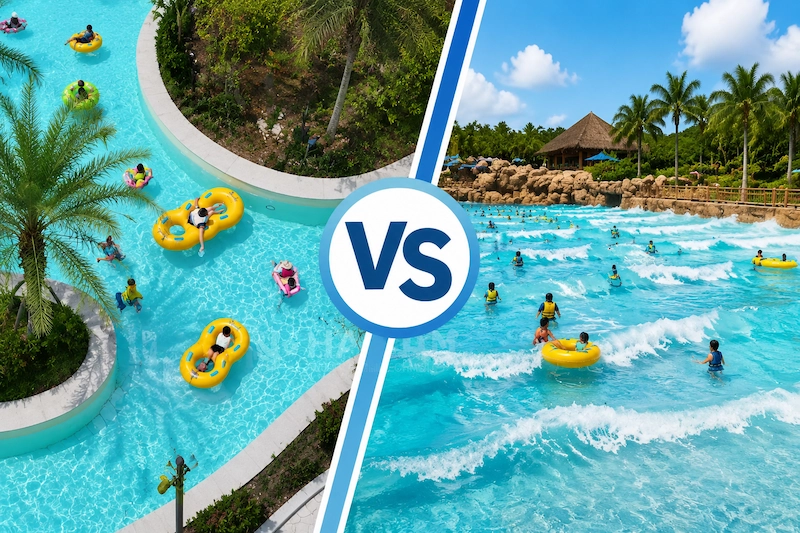
A lazy river is the preferred choice for projects focused on family-friendly appeal, lower operational complexity, and steady visitor flow, while a wave river is recommended for parks aiming to create high-energy attractions, stronger visual impact, and premium ticket positioning. Most experienced river water park suppliers suggest selecting based on target demographics, land availability, and long-term operational budget rather than trend alone.
What Is the Difference Between a Lazy River and a Wave River?
A lazy river is a gently flowing water channel designed for relaxation. It uses low-speed circulation systems to carry guests along a loop, typically with floats or tubes.
A wave river, on the other hand, combines directional water flow with artificial wave generation, creating a more dynamic and interactive experience. It mimics ocean-like motion within a controlled channel.
Key Technical Differences
| Feature | Lazy River | Wave River |
|---|
| Water Flow | Continuous, low-speed | Variable speed + wave pulses |
| Experience | Relaxation, passive | Excitement, active |
| Equipment Complexity | Moderate | High |
| Energy Consumption | Lower | Higher |
| Target Audience | Families, all ages | Teens, thrill-seekers |
Which Option Do River Water Park Suppliers Recommend?
Experienced river water park suppliers typically recommend:
Lazy rivers for:
Resorts and family-oriented parks
Medium budgets with stable ROI goals
Projects requiring high capacity with minimal supervision
Wave rivers for:
Large-scale destination parks
Competitive markets needing standout attractions
Investors targeting higher ticket pricing and differentiation
In practice, many top-tier parks integrate both to balance relaxation and excitement.
Why Do Aqua Park Equipment Suppliers Often Favor Lazy Rivers for ROI?
From a commercial standpoint, many aqua park equipment suppliers recommend lazy rivers as a baseline attraction.
1. Higher Throughput Efficiency
Lazy rivers can handle a continuous stream of visitors, reducing congestion in other attractions.
2. Lower Maintenance Costs
3. Longer Guest Stay Time
Guests tend to spend more time floating, increasing per-visitor engagement and spending opportunities.
When Is a Wave River the Better Investment?
Despite higher costs, wave rivers offer strategic advantages.
1. Strong Visual & Marketing Appeal
Wave rivers create dynamic movement, making them ideal for promotional content and branding.
2. Competitive Differentiation
In saturated markets, a wave river helps position your park as premium and modern.
3. Upsell Potential
Operators can bundle wave river access into:
VIP areas
Premium tickets
Special events
How Much Does a Lazy River vs Wave River Cost?
Lazy River Cost Factors
Channel length and width
Pump system size
Landscaping and theming
Typical investment: Moderate
Wave River Cost Factors
Typical investment: Significantly higher (often 1.5–2× lazy river)
What Design Factors Should You Consider Before Choosing?
1. Land Availability
2. Power & Infrastructure
Wave rivers demand:
3. Safety Management
Lazy rivers: lower risk, easier supervision
Wave rivers: require lifeguard density and safety protocols
Which Option Attracts More Visitors?
It depends on your audience.
Leading river water park suppliers often recommend combining both to maximize demographic coverage.
Can You Combine Lazy River and Wave River in One Park?
Yes—and this is increasingly common.
Hybrid designs may include:
This approach:
Balances relaxation and excitement
Improves visitor distribution
Enhances overall park value
Which Option Is Easier to Maintain?
Lazy rivers are generally easier to maintain due to:
Wave rivers require:
How Do You Choose the Right River Water Park Suppliers?
Selecting the right partner is critical.
Look for aqua park equipment suppliers that offer:
Custom engineering solutions
Proven project portfolios
Compliance with international safety standards
Full lifecycle support (design → installation → maintenance)
Are Lazy Rivers or Wave Rivers More Profitable?
Profitability depends on positioning:
The best-performing parks align the attraction type with:
Target audience
Pricing strategy
Local competition
Conclusion
Choosing between a lazy river and a wave river is not about which is “better,” but which aligns with your business model and market positioning.
Lazy rivers deliver reliable returns, broad appeal, and operational efficiency, while wave rivers provide excitement, branding power, and premium differentiation.
For most projects, experienced suppliers recommend a balanced combination, ensuring your water park appeals to both relaxation seekers and thrill enthusiasts—maximizing both visitor satisfaction and revenue potential.
FAQs
What is the main advantage of a lazy river in a water park?
It offers continuous capacity, low maintenance, and universal appeal, making it a core attraction for most parks.
Are wave rivers safe for children?
Yes, when properly designed, but they require strict supervision and designated safety zones.
Do wave rivers consume more energy than lazy rivers?
Yes, due to wave generation systems and higher water dynamics.
How long does it take to build a river attraction?
Typically 3–6 months, depending on complexity and scale.
Should small water parks invest in a wave river?
Not always. Smaller parks often benefit more from lazy rivers due to lower cost and broader usability.


